Ashtanga Yoga Opening and Closing Prayer/Mantra
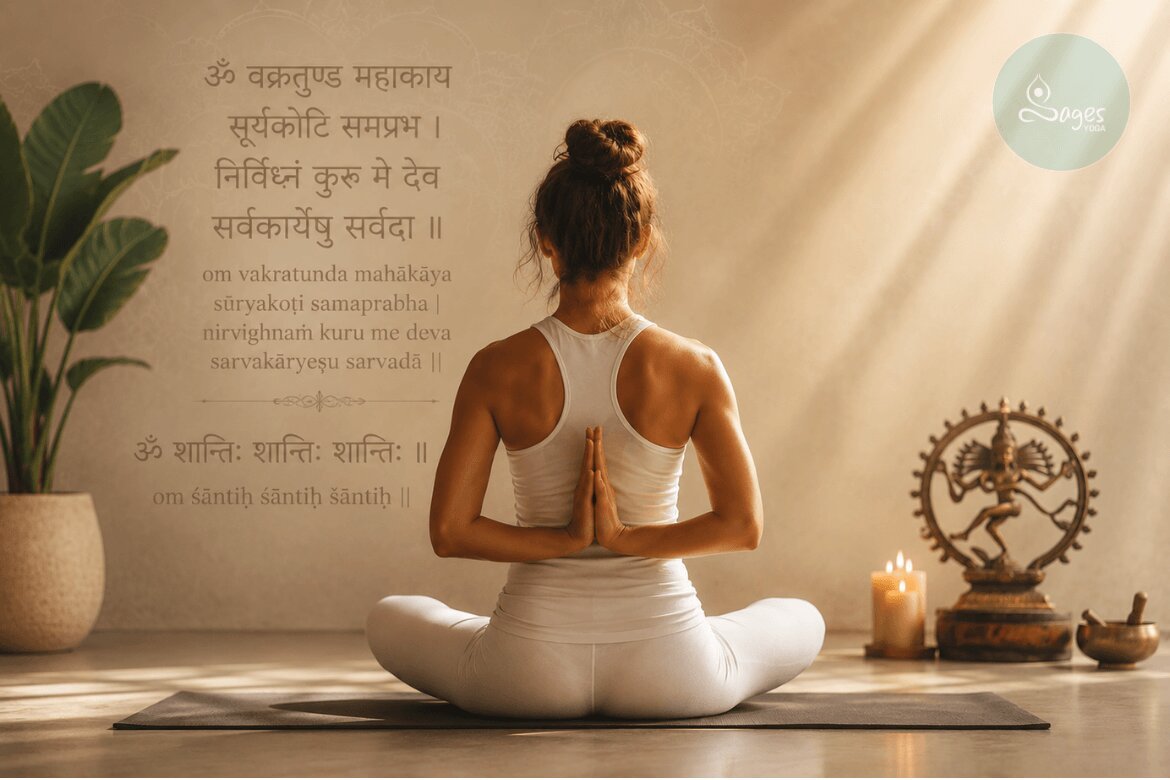
All Ashtanga Yoga classes at Sages Yoga start and finish similarly— not with a warm-up, not with breathing exercises, but with a chant. It starts with one, and it ends with one as well. You know how it feels when you have sat in a shala and heard a room full of Sanskrit words you do not yet know. Something shifts the air changes. You forget about your to-do list, your sore hamstrings, and your unread mail. You arrive. Your mind begins to relax while remaining aware of your surroundings. This is precisely what these prayers accomplish.
Here is a guide to the opening and closing prayers of Ashtanga Yoga. You will learn the Sanskrit text, its transliteration, the meaning of each line, and why these mantras occupy such a special place in the Ashtanga tradition.
The Values of the Ashtanga Yoga Opening Prayer
The Ashtanga opening prayer has various mantras. The teachers refer to it as the Vande Gurunam mantra, the opening song, or the invocation. It has its origins in the Vedic tradition and glorifies the heritage of yoga teachers who have passed this practice on for thousands of years.
Imagine it is a bow. You bow down before you get on the mat— before all the teachers who taught a student, who taught another teacher, who taught the one who taught you. You admit that such practice did not emerge out of the air. It was made with hands and hearts, and over the generations, it was given to you.
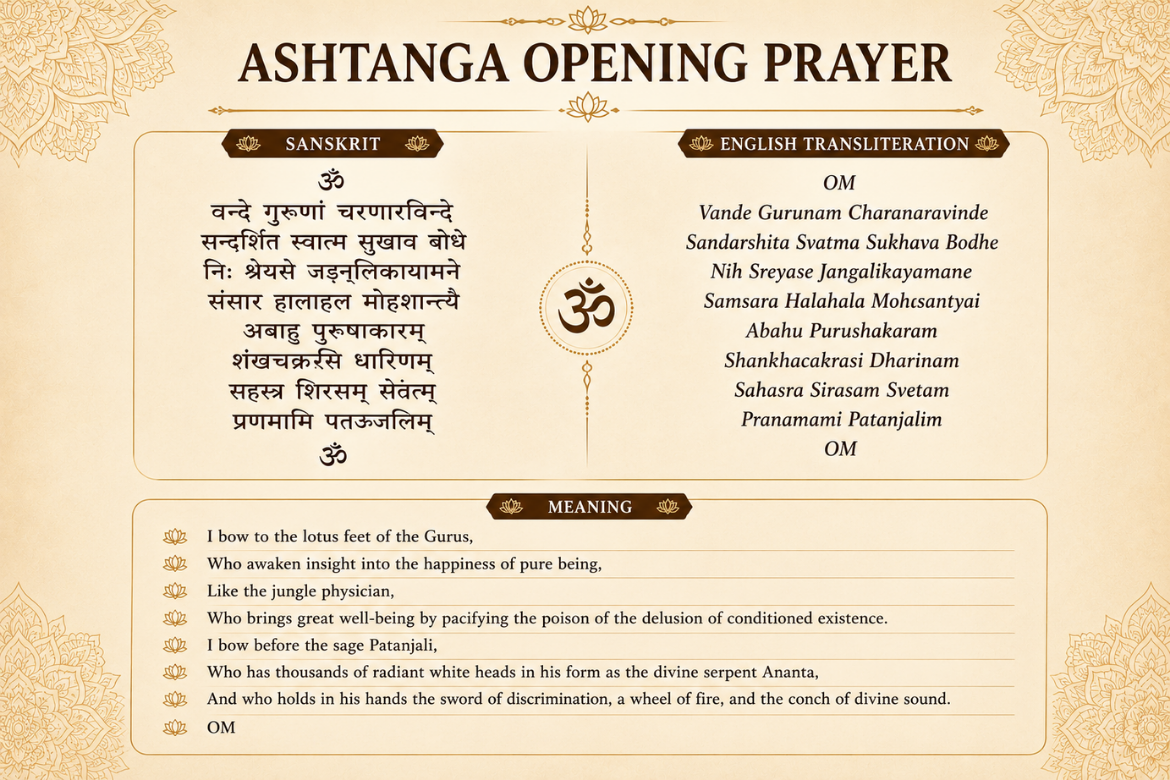
This chant was taught by Sri K. Pattabhi Jois, the man who introduced Ashtanga Yoga to the modern world, at his Mysore shala. He introduced yoga to all continents through his students. Today, Ashtanga students in New York, Bali, and Mumbai begin their practice with the same words.
Ashtanga Opening Prayer: Transliteration and Translation and Sanskrit
ॐ — OM
Universal sound of peace and consciousness.
वन्दे गुरूणां चरणारविन्दे — Vande Gurunam Charanaravinde
I bow to the lotus feet of the Gurus.
सन्दर्शित स्वात्म सुखावबोधे — Sandarshita Svatma Sukhava Bodhe
Who awaken the understanding of true inner happiness.
नि: श्रेयसे जाङ्गलिकायमाने — Nih Sreyase Jangalikayamane
Who act like a jungle physician bringing supreme well-being.
संसार हालाहल मोहशान्त्यै — Samsara Halahala Mohasantyai
Who remove the poison of illusion in worldly existence.
अबाहु पुरुषाकारं — Abahu Purushakaram
Whose form is human from the waist up.
शङ्खचक्रासि धारिणम् — Shankhacakrasi Dharinam
Who holds the conch, discus, and sword.
सहस्र शिरसं श्वेतं — Sahasra Sirasam Svetam
Who has a thousand radiant white heads.
प्रणमामि पतञ्जलिम् — Pranamami Patanjalim
I bow before Sage Patanjali.
ॐ — OM
The sacred sound of universal unity.
Line-by-Line Translation:
"I bow to the lotus feet of the Gurus,
Who awaken insight into the happiness of pure being,
Like the jungle physician,
Who brings great well-being by pacifying the poison of the delusion of conditioned existence.
I bow before the sage Patanjali,
Who has thousands of radiant white heads in his form as the divine serpent Ananta,
And who holds in his hands the sword of discrimination, a wheel of fire, and the conch of divine sound."
Significance of the Ashtanga Yoga Opening Mantra
The first verse expresses gratitude. You bow before the lotus feet of any gurus— those who showed you the way to your own inner joy. The term “jungle physician” has a certain ring to it. A doctor in the forest uses whatever is available to treat disease. The guru does the same. He employs life itself, firsthand experience, and the doctrines of yoga to heal the most profound human affliction— what the text calls the poison of conditioned existence.
That Sanskrit word in the text is Samsara, which means the endless cycle of attachment, loss, and craving that most people live within without knowing it. The guru is a skilled healer; he helps you see through it.
The latter verse talks directly to Patanjali. Yoga Patanjali is the sage who authored one of the most foundational texts of yoga philosophy, the Yoga Sutras. Most commonly, he is shown in a half-human, half-serpent form. His hand grasps three items: a conch, symbol of divine sound; a discus, symbol of time; the wheel of dharma; and a sword, symbol of discrimination (the mental faculty for differentiating between truth and illusion).
When you say this prayer, you are not worshipping a God. You are aligning your mind with the lineage, the teaching, and the purpose of the practice. You are saying: I come here to learn. I come here open. I am here to be truthful to myself.
Ashtanga Closing Mantra: The Mangala Mantra
This practice ends with a closing prayer. Where the opening prayer is inward, to thanksgiving and descent, the closing prayer is outward. It wishes well to all living things.
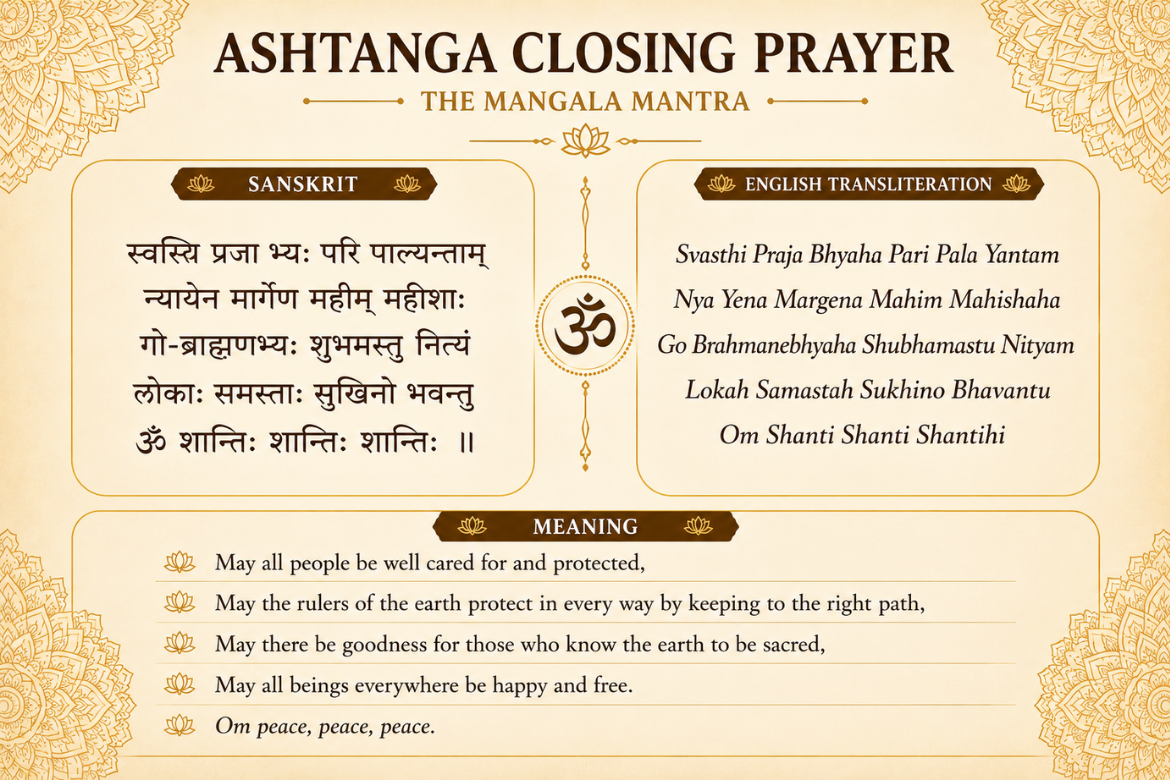
This mantra is known as the Mangala Mantra. Mangala is a Sanskrit word meaning auspicious, blessed, and full of goodness. You do not step off the mat and back into the world immediately after a physically demanding and mentally charged practice. You pause. You want the world to be better. It is a beautiful antidote to the ego.
Ashtanga Closing Prayer
स्वस्ति प्रजाभ्यः परिपालयन्ताम् — Svasthi Praja Bhyaha Pari Pala Yantam
May all people be well cared for and protected.
न्यायेन मार्गेण महीं महीशाः — Nya Yena Margena Mahim Mahishaha
May the rulers of the earth protect the world through the path of righteousness.
गोब्राह्मणेभ्यः शुभमस्तु नित्यं — Go Brahmanebhyaha Shubhamastu Nityam
May there always be goodness and prosperity for all beings and sacred wisdom.
लोकाः समस्ताः सुखिनो भवन्तु — Lokah Samastah Sukhino Bhavantu
May all beings everywhere be happy and free.
ॐ शान्तिः शान्तिः शान्तिः ॥ — Om Shanti Shanti Shantihi
Om peace, peace, peace.
Line-by-Line Translation:
"May all people be well cared for and protected,
May the rulers of the earth protect in every way by keeping to the right path,
May there be goodness for those who know the earth to be sacred,
May all beings everywhere be happy and free.
Om peace, peace, peace."
Significance of the Ashtanga Yoga Closing Mantra
The first three lines are meant to be social. They also state that they would wish for leaders to rule with justice, for the earth and everyone on it to be treated with respect, and for the fraternity of practitioners to possess knowledge with humility and care.
The fourth line, Lokah Samastah Sukhino Bhavantu, is one of the best-known Sanskrit Sutras in yoga. Lokah means world or universe. Samastah implies everything. Sukhino is happy, peaceful. Bhavantu means may they be. Together, may we wish all creatures in all worlds to be happy and free.
This line is not confined to its compassion to the people you like or the practitioners in your shala, and even the human species. It includes everything. All the living things everywhere. That is a big thing to fit after 90 minutes of bodily activity. This is exactly what makes it work.
The last line, Om Shanti Shanti Shantihi, is repeated three times, as yoga philosophy recognizes three types of suffering: sickness, suffering caused by others, and suffering beyond your control, such as illness or natural events. Each of them is directly addressed three times with Shanti, which means peace.
Importance of Ashtanga Yoga Opening and Closing Prayer
You do not need years of study or spiritual qualifications to chant these mantras. You have to be present with good intentions.
These prayers are not an ornamental part of a yoga class. They are used with a distinct purpose. The introductory chant immerses your mind in and out of the bustle of the day. Studies published in the medical literature indicate that chanting lowers heart rate and blood pressure and releases endorphins. In this way, chanting prepares you for practice just as much as any physical warm-up does.
The last closing chant does just the opposite. It helps to avoid the sudden reentry into everyday stress. You arrived at the mat, weighed down by the burden of normal life. The custom bade you lay that aside. The closing mantra does not ask you to take it all back up at the end of the classes. It provides you with a conscious passage.
These two prayers combine to form a container. Everything within it — from the first Om to the last Shantihi, are all practice. Not competition, not performance, not exercise. Practice.
Conclusion
Start by listening. Several Ashtanga teachers, including those at Sages Yoga, recite these prayers at the start and end of class. The first time, listen without trying to follow it. Lift the sound at you. Be aware of your emotions. When you are ready to chant, you can use a transliteration such as that used in this article. Divide the lines into tiny parts. Memorize a line at a time. Do not rush. The mantra is no race to the finish; it is a dialogue with the practice.
Sing loudly when you are sure enough. There is a vibration in your own chest which your own voice makes, which is reproduced in silence by no other repetition. But having said that, complete mental concentration in silent chanting is also acceptable. Volume is not important. It is the intention that is important.
Frequently Asked Questions
Should I chant the Ashtanga prayers?
These mantras are not based on any particular religion but are in Sanskrit. They bear universal will, appreciation, ancestry, tranquility and compassion. Chanting them with pure intention is beneficial for anyone, regardless of their faith or background.
What is the actual language of the Ashtanga mantras?
The opening prayer and closing prayer are both in the ancient Indian language of Sanskrit. The yogic tradition regards Sanskrit as the language of direct experience, and its sounds have a vibrational value that goes beyond the literal meaning of the words.
Is it okay to chant the mantras silently?
Yes. Clear mental focus, as silent chanting is worth all in the Ashtanga tradition. It is attention and sincerity, but not volume, that count in the quality of the chant.
Why is the closing prayer three times om Shanti?
The three times of Shanti refer to three different causes of suffering: self-inflicted suffering, inflicted by others, and suffering inflicted by forces beyond human control. There are three repetitions, which are in search of peace in all three directions.
Do beginners need to learn the mantras before their first Ashtanga class?
No. You do not need to know the mantras before practise ashtanga yoga. Listen and observe. The rhythm and meaning will sink in with time.
Categories
Our Popular Yoga Courses
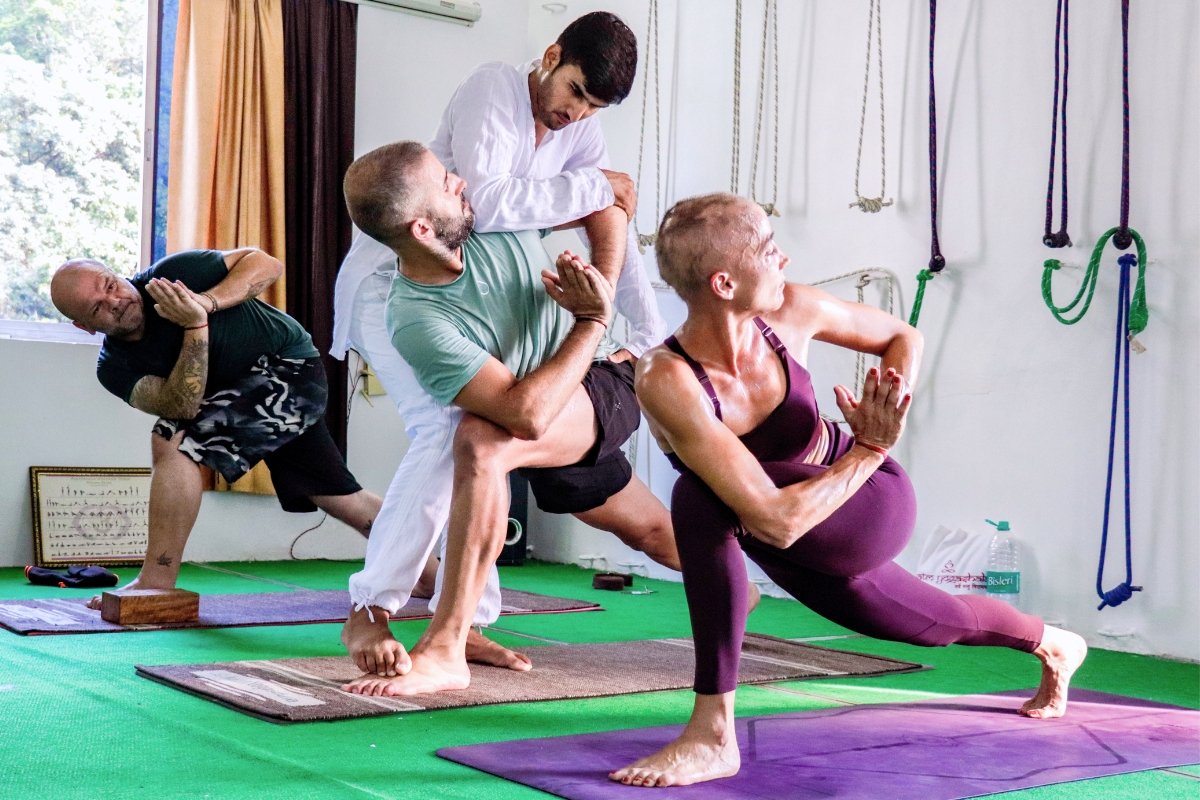
Yoga Teacher Training Courses in Rishikesh, India
Join our Yoga Alliance certified 100 to 500 Hour Yoga Teacher Training in Rishikesh — the Yoga Capital of the World. Learn from expert Indian gurus.
200 Hour Yoga Teacher Training in Rishikesh
Yoga Alliance certified TTC for students who want to become professional yoga teachers.