Half Moon Pose: Guide to Chandrasana to Build Balance & Calm
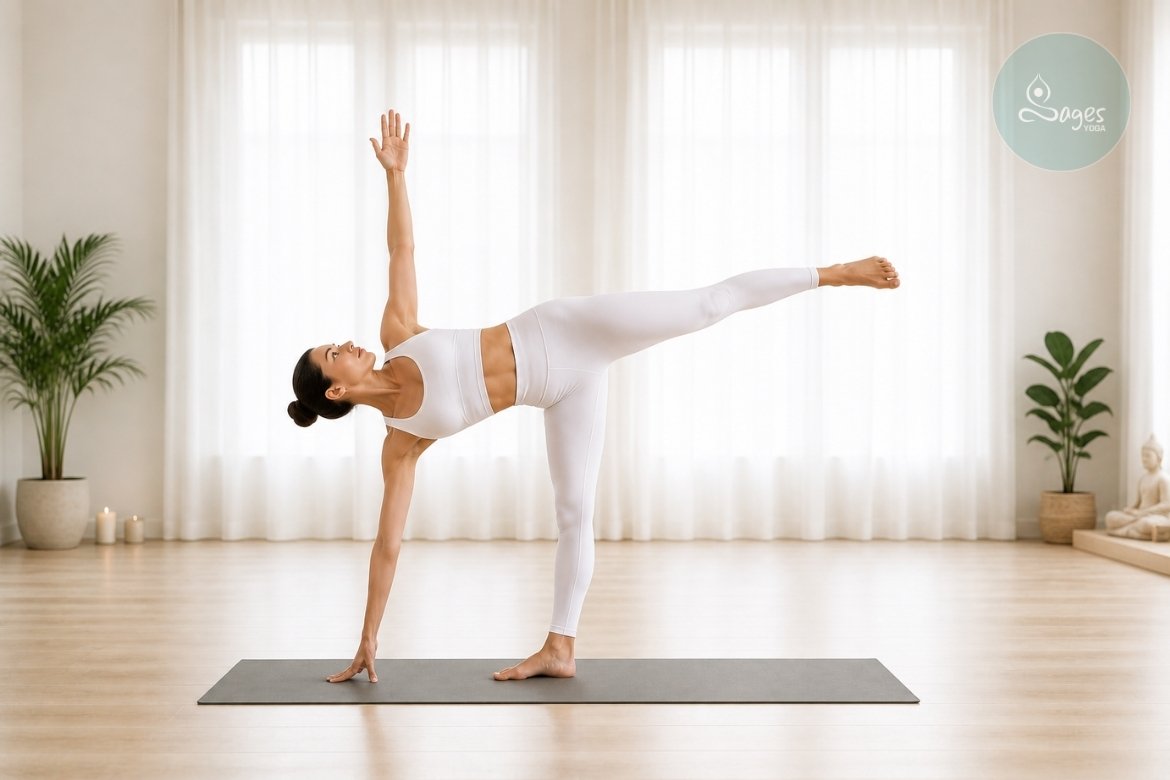
Half Moon Pose embodies the moon's characteristics. With a daily practice of this moon yoga pose you can bring peace to your mind and balance to your life. It has a certain grace — balancing on one leg while opening your whole body out to the side like a crescent toward the sky. The pose is known as Ardha Chandrasana, or Half Moon Pose. It is a standing balance pose in the Hatha yoga tradition and may appear easy to learn at a glance.
But each time you get on the mat, it will share something you did not know before. Each pose has a story, a mission, and something deeper than the form at Sages Yoga. Ardha Chandrasana is no exception. The Ardha Vakrasana pose can bring something significant to you, whether you are a beginner who is on first unsteady steps to balance, or an experienced practitioner who needs to enrich the standing sequence.
Get all you need to know about Ardha Chandrasana, from its rooted culture to its benefits and contraindications. Learn everything through this comprehensive guide and practice daily.
The Rooted Culture of Ardha Chandrasana
Ardha Chandrasana is named after three Sanskrit words. Ardha translates to 'half,' Chandra to 'the moon,' and asana to 'posture.' They collectively depict a half-moon-shaped body with one leg stretched horizontally toward the earth, both arms stretched away, one to the east and the other to the west, and the chest open to the horizon.
The half moon pose is a standing balance pose in classical Hatha yoga. The Chandrasana is inspired by the moon, which, in yogic philosophy, symbolizes stillness, intuition, and the soothing energy of the body. Other than the half moon pose, the crescent yoga pose is another type of moon yoga that builds the hip stability and spinal extension needed to feel confident in Ardha Chandrasana.
You are not exercising just physical balance when you practice Ardha Chandrasana. You are conditioning your nerves to remain stable in a situation that appears to be unstable. Daily practice of moon yoga poses can help you connect your body with inner peace.
A Quick Guide to Perform Half Moon Pose
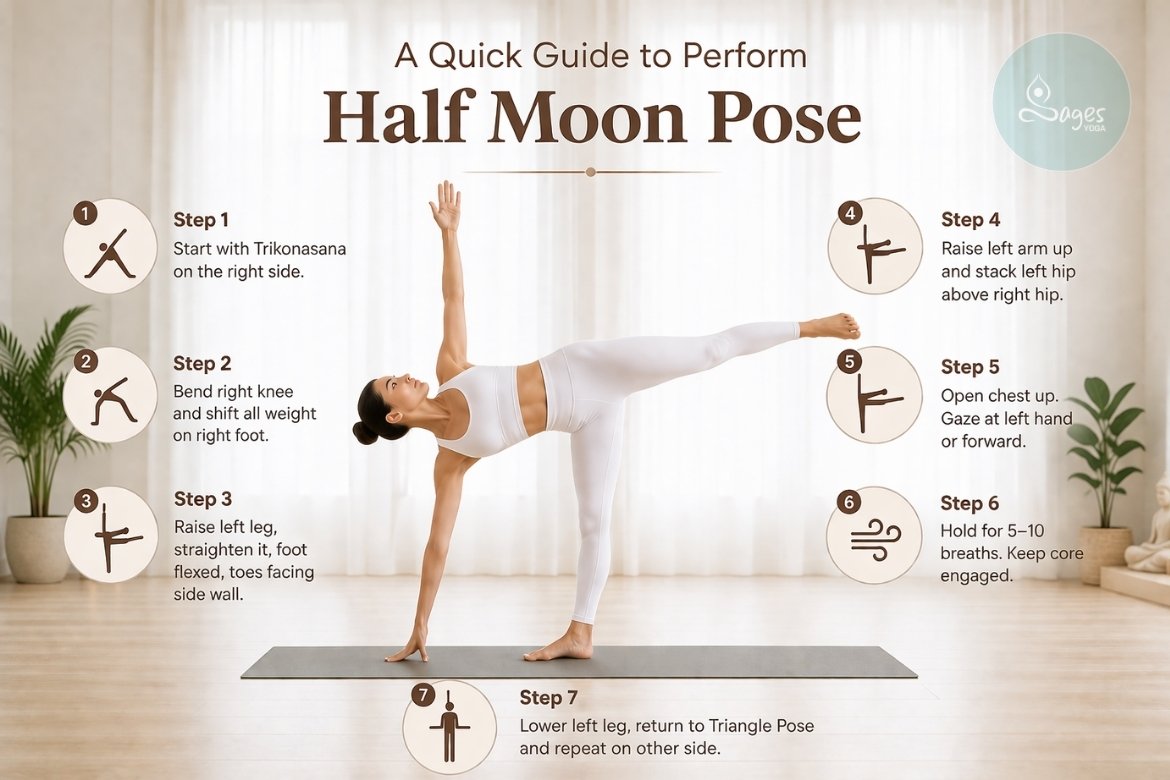
A yoga mat will be required to perform Ardha Chandrasana. Here is a step-by-step guide to learn the yoga pose.
- Step 1:- Start with Trikonasana (Triangle Pose) on the right side, and place your right hand on the floor or a block beside your right foot.
- Step 2: Slightly bend your right knee and shift all your weight onto your right foot.
- Step 3: Raise your left leg off the ground and straighten it, with the foot flexed and toes facing the side wall.
- Step 4: At the same time, raise your left arm toward the ceiling and stack your left hip directly above your right hip.
- Step 5: Open your chest upward and gaze toward your left hand, or keep your gaze forward if your balance is shaky.
- Step 6: Hold the pose steady for five to ten breaths, keeping your standing leg straight and your core engaged.
- Step 7: Carefully lower your left leg back to the floor, return to Triangle Pose, and repeat on the opposite side .
Why This Pose Should be Included in Every Practice Session
The Half Moon pose benefits are far more than what a normal standing stretch would provide. This pose engages your whole body up to the ground - and reaches the mind as well.
- Strengthens the Legs and Glutes:- Ardha Chandrasana is a demanding pose for the standing leg. The quadriceps, hamstrings, and gluteus muscles all come into play to keep you stable on a single foot. This will develop good functional leg strength over time, which is transferred to normal movement.
- Improves Balance and Proprioception: Standing on a single leg makes your brain and body communicate more accurately. Regular exercise sharpens your coordination and spatial awareness, which aids daily activities and reduces the risk of falls and injuries.
- Lifts the Hips and Joints: The raised leg creates an opening in the hip flexors and the inner groins of both legs. It is among the most valuable benefits of the half moon pose for individuals who spend most of their time sitting at desks. Repeated practice will loosen tight hips.
- Stretch the chest, shoulders, and Spine: The thoracic spine is laterally stretched as your arms stretch out, and your chest opens. It will ease the tightness in the mid-back and shoulder area that builds up from poor posture and screen-heavy routines.
- Strengthens the Core: To maintain Ardha Chandrasana, you have to use your abdominal muscles, obliques, and spinal extensors throughout. The core remains silent, though it works consistently during the posture and becomes stronger with each breath that you take.
- Calms the Mind: Ardha Chandrasana is a pose that embodies the moon's cooling, reflective energy. After practicing this pose, practitioners report feeling mentally steady. The need to maintain balanced focus is so intense that there is little room for scattered thinking, making this moon yoga pose one of the most effective for developing present-moment awareness.
When You Should Not Practice Ardha Chakrasana?
There are limits to every yoga pose. Being aware of the ardha chakrasana contraindications makes your practice safe and sustainable.
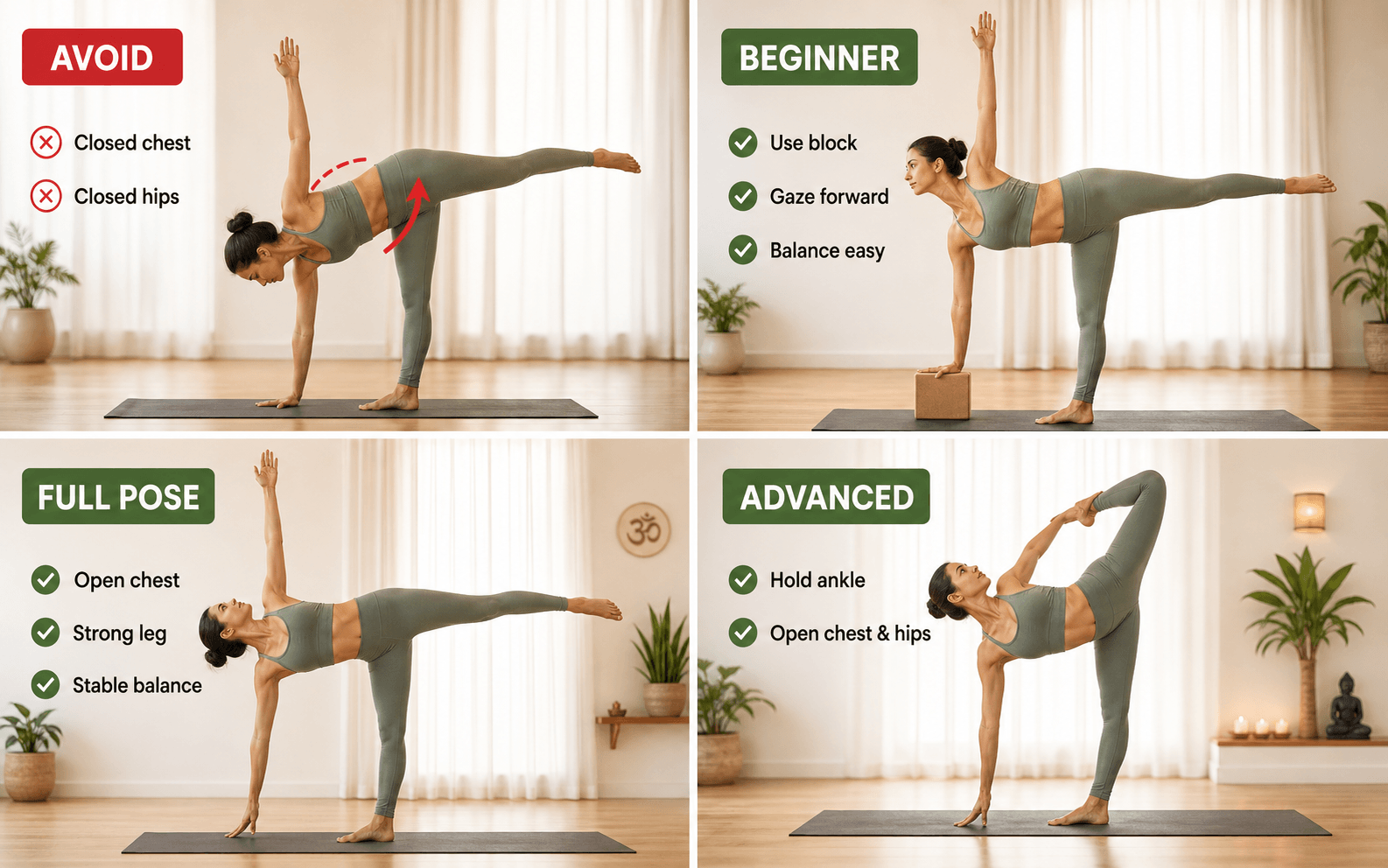
- Neck injuries:- In Ardha Chandrasana, looking up can strain the cervical spine. If you have neck pain, disc problems, or a cervical injury, it is better to look straight ahead rather than up.
- Low blood pressure: Individuals with hypotension may experience dizziness in balancing postures with lateral stretch. Gradually come out of the pose and lean against a wall.
- Knee injuries: You are on one leg, bearing the full weight of your body. Use a block, shorten the duration, and avoid locking the knee in full extension if you have a knee injury or ligament instability.
- Lower back pain:If you have lumbar spine sensitivity, keep the lifted leg below parallel to the ground and use a block to reduce the side bend. All these contraindications of ardha chakrasana are equally applicable to ardha kati chakrasana, which is also a lateral bending action.
- Migraine or active headaches: Do not balance during a migraine. Instead, lie on your back.
- Pregnancy: During the second or third trimester, women should not fully perform Ardha Chandrasana. It is safer with a supported wall version, where the hands are placed on the wall.
Individuals with spondylitis are advised to practice Ardha Chandrasana with caution, under the guidance of a qualified yoga instructor, before attempting them on their own.
You May Also Like : 10 Yoga Poses to Help You Find Better Posture Fast
Conclusion
The moon - Chandra - is an aspect of yogic philosophy that signifies the cooling, introspective energies of the body and mind. Chandra controls the tides, emotions, and the cyclic aspect of life. The chandrasana seat links you to this lunar energy and stimulates a more contemplative, more inward way of being. It is a moment of change, neither whole nor lacking. This moon yoga pose calls you to seek stability within yourself. It is a lesson that you can take way beyond your yoga.
Ardha Chandrasana is one of the most expressive poses observed in the standing sequence at Sages Yoga. It requires all of you in terms of strength, flexibility, focus, and surrender, and returns the same. Get into your mat, and allow the moon to teach you to be still.
Frequently Asked Questions
What is the difference between the crescent yoga pose and Ardha Chandrasana?
Ardha Chandrasana is a one-legged standing balance that is laterally extended. The crescent pose is a low lunge in which the arms are stretched above in an arc. Both develop hip flexibility and balance, but they target different muscle groups, and varying degrees of stability are required.
Who should not practice Ardha Chandrasana?
Individuals having knee injuries, neck issues, low blood pressure, or lower back complications must take this pose cautiously. These are very similar to the Ardha Chakrasana contraindications and should be modified or advised by a teacher.
What is the role of Ardha Kati Chakrasana in preparing Ardha Chandrasana?
It heats the same side-body muscles, obliques, intercostals, and hip abductors— that Ardha Chandrasana relies on. Use it as a warm-up practice.
What are the most important Half Moon Pose benefits?
Some of the key benefits of Half Moon pose include stronger legs, better single-leg balance, open hips and groin, lateral spinal stretch, a stronger core, and a calmer, more focused mind.
Is it possible to use Ardha Vakrasana and Ardha Chandrasana in the same session?
Yes, these two poses complement each other well. Ardha Chandrasana provides lateral extension in standing, and Ardha Vakrasana provides rotation of the spine on the floor. Together, they combine to provide a complete and balanced workout for the spine.
Categories
Our Popular Yoga Courses
Yoga Teacher Training Courses in Rishikesh, India
Join our Yoga Alliance certified 100 to 500 Hour Yoga Teacher Training in Rishikesh — the Yoga Capital of the World. Learn from expert Indian gurus.
200 Hour Yoga Teacher Training in Rishikesh
Yoga Alliance certified TTC for students who want to become professional yoga teachers.