Salabhasana (Locust Pose) for Strong Back and Flexibility
.webp "Salabhasana (Locust Pose)")
Locust Pose Salabhasana is a medium level backbend pose that extends your whole back, spine, chest and makes you feel refreshed and revitalized. Its name is pronounced as sha-la-BAHS-anna and is formed by combining the words Salabha (meaning locust) of Sanskrit and Asana (meaning posture) of Sanskrit. The Salabhasana (Locust Pose) is also referred to as the Grasshopper pose. Salabhasana (Locust Pose) is a powerful back-strengthening yoga posture.
Backbends scare many away. The concept of contravening the natural way of the body is a challenge indeed. We are used to leaning forward and moving backward, moving backward and forward may be a frightening experience. Practicing locust posture yoga helps improve spinal flexibility. So, saying that, there is no denying the fact that backbends are beautiful and they are wonderful to feel. More so, they are a source of immense power, flexibility and balance and are significant in a balanced yoga practice.
How to Do Locust Pose: Stepwise Instructions?
Below are the steps to perform locust pose:-
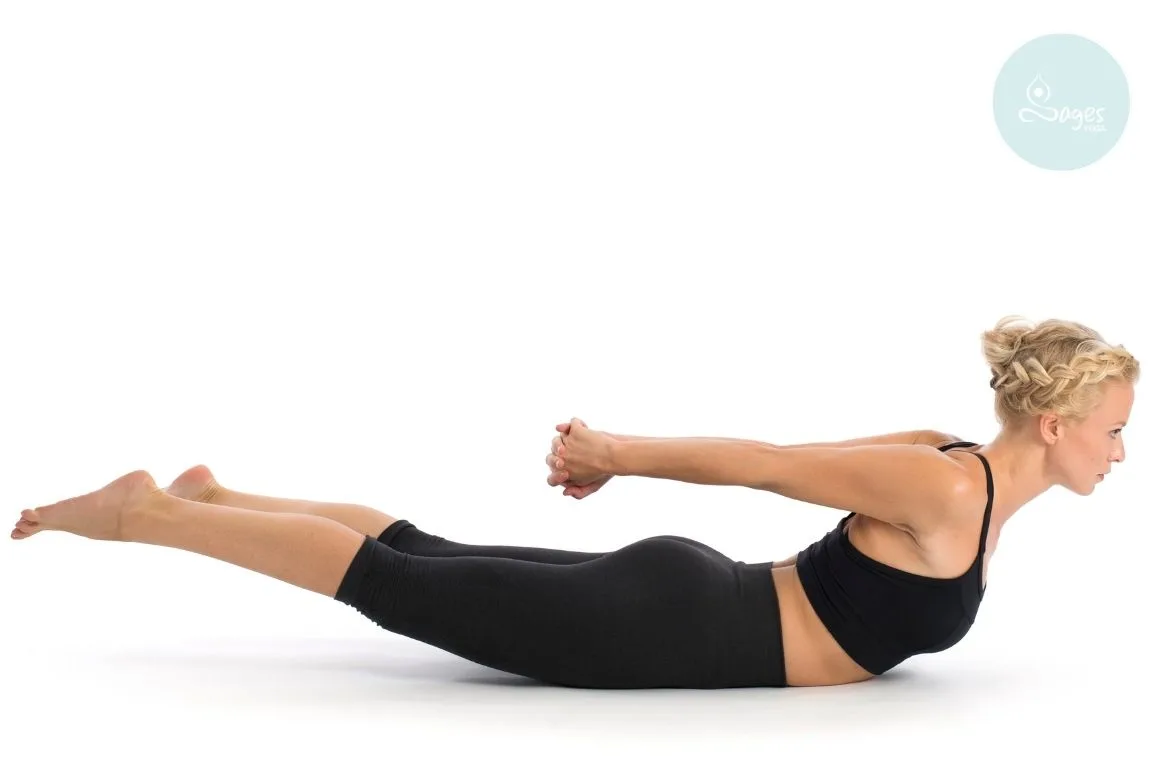
- Lie down on your belly with your chin or forehead on the floor with your hands along your sides with palms down.
- Press your pubic bone on the floor to anchor your pelvis to your mat and form a strong point of contact.
- Squeeze your feet on the top to use your legs and pull your knees out of the ground.
- Squeeze into the palms of your hands.
- Breath in and raise your head and shoulders as far as you are comfortable.
- Release your shoulders off your ears and pull your shoulder blades towards the spine.
- Sit in this pose for a few breaths, with each breath raising you a bit higher.
- Put your head and shoulders on the floor with a breath out and turn your cheek on one side and take a few breaths.
- In your second round do the same lift, only now, lift your arms, winging them out behind you, as well.
- In the third round, raise your head, shoulders, arms and legs off the ground. Being one of your points of resistance, you should not be surprised that now your chest is a bit lower.
- Use your glutes, legs, and feet, and even your toes.
- Breath deeply and relax after a few breaths. The benefits of locust pose include better posture and stronger lower back.
Proper Alignment for Practising Locust Pose
Following are the proper alignment for Practising Locust Pose.
- Anchor Your Pelvis:- Locate a small anterior tilt of the pelvis by pushing the pubic bone downward in order to establish a deep point of contact with the floor.
- Engage Your Glutes:- Engage your butt muscles to support the anchoring effect of your pelvis and support the lower back.
- Keep Your Neck Neutral:- Raise your head to a neutral position. Look straight or even a little bit below.
- Don’t Forget to Breathe:- Ride on the waves of your breath, and each inhalation of air makes your chest rise a little higher with the expansion of your lungs.
Guidelines to Do Salabhasana
Despite being an introductory pose, Salabhasana is also a challenging pose, which needs some consideration.
- Start slow. It is unnecessary to strain yourself to maintain a backbend before your body is prepared. Relax in the pose and adjust accordingly. Salabhasana is commonly used to strengthen the core and back muscles.
- Pay attention to the bend over the lift. The first time you attempt the locust pose, you need not concern yourself with what height you can bring the locust. Rather, you should open your chest, and equally stretch the bend on the upper back, middle back and lower back to prevent strain.
- Be conscious of your breath. You should not hold your breath because you are in a position and your muscles require oxygen and a consistent inhale-exhale rate will make your body do the best it can.
- Know your body. It should not be tried by those with acute back pain, slipped disc, neck injury, sciatica, high blood pressure and pregnant women as it could be harmful. Consult your primary care provider about any concerns prior to this exercise.
Locust Pose Variations
To expand on your yoga practice, you can slowly increase your locust pose up to ten breaths keeping a good form. Yoga on stomach like this pose helps activate the posterior body. To make the pose harder, the following are two more advanced forms of the pose:-
- Clasp your hands together. You do this by lifting up with your fingers interlaced behind the back and involving your back and upper torso even more.
- Take flight. Reach your arms to the sides of your body and upwards, as opposed to behind, placing more load on your shoulders and core.
Read Also:- Halasana Yoga Pose Benefits
Practising Errors and How to Fix them
Knowing the most frequent errors can make you perfect your practice and prevent injury:-
1. Lifting too High Quickly
- Error: Lifting beyond the range and ability you already have and forming more of an arch in your low back, and may strain.
- Fix: Think about a more regulated and conscious lift, although that may not be as much lift. Pay more attention to the lengthening of the spine.
2. Straining the Neck
- Error: Lifting the head excessively or straining the neck to the point of stress to your cervical spine.
- Fix: Have your eyes fixed forward or slightly down so that your neck is in a neutral position in the spine.
3. Using Momentum to Lift
- Error: The jerking of the legs or body position instead of using a combination of muscles in a controlled way.
- Fix: Muscles of the back and glutes, slowly and deliberately. Concentrate on the lifting by the strength of the core and not a swing.
Shalabhasana Contraindications to Keep in Mind
As much as Shalabhasana has its benefits on the mind and body it is important to consider the contraindications of the pose since the pose has an effect on the lower back and other body parts. The locust yoga position improves balance and body awareness.
- You are not allowed to practice this pose in case you have back pains or issues with your back.
- It is not a good pose in individuals with significant menstruation problems or prolapsed uterus.
- Persons having issues with blood pressure should not do this pose because they may be suffocated.
- This pose should not be done by pregnant women.
- When you experience acute sciatica, then you should not use this position because it causes tightness to the lower body between the hips and feet.
- You should not do this pose in case you have had a back, shoulders or neck injury in the recent past.
- Individuals with heart complications, hernia, glaucoma or hip arthritis are not supposed to practice this yoga asana.
Who Should not do Salabhasana (Locust Pose)?
Salabhasana, although very advantageous, cannot be applied to all people. Sarala matsyasana is another yoga pose that helps open the chest gently. You need to pay attention to your body and talk to a medical practitioner or an advanced yoga teacher in case you have any underlying illnesses. Contraindications of Salabhasana include:=
- Lower Back Pain:- This pose puts pressure on your spine and can aggravate your injury, in case of an acute lower back injury or in case of a recent back surgery.
- Herniated Disc or Sciatica:- Your lower back can be compressed to worsen your condition.
- Pregnancy:- You should not put pressure on your belly when pregnant.
- Abdominal Surgery:- In case you just had an abdominal surgery, then you must give yourself time to heal before trying this pose.
- High Blood Pressure or Heart Problems:- Inversions and weight on the chest may not be safe in case you have had a history of high blood pressure or heart problems.
- Neck Injuries:- Before practicing this pose, you have to make sure that your neck is healthy.
The Benefits of Practising Salabhasana (Locust Pose)
When practiced on a regular basis, Shalabhasana offers numerous physical advantages:-
1. Effective in Lower Back Pain
Shalabhasana is the practice of raising the lower part of the body with the assistance of the belly that causes tightening of lower back muscles. Regular practice shows many salabhasana benefits for overall fitness. It is also known to bring stability to the spine as it attacks it more specifically as compared to the forward bends. In this way, it supports the lower back, fixes the back pains and tightens the muscles of the lower back.
2. The aid in Premenstrual Syndrome
PMS or premenstrual syndrome is a condition that is described as having several physical, psychological, emotional, mental, and genetic causes. The salabhasana pose is ideal for improving back strength. Shalabhasana practising is known to activate the hormones, relax the muscles, and build up the pelvic and abdominal muscles. Thus, it could be useful in decreasing the period-related pains.
3. Improves Spine Flexibility
The backbend Shalabhasana is the one that targets the whole spine. Raising the chest and bending back enhance strength and flexibility of the spine. This pose also helps to cure the stiffness of the spine and promote the healthy movement of the back and the vertebral column. Purna shalabhasana is the advanced version of the locust pose.
The salabhasana pose is ideal for improving back strength as well. Purna shalabhasana is the advanced version of the locust pose that is beneficial for the overall well being. The Shalabhasana pose requires a lot of focus and balance in practicing. Thus, it may assist in enhancing psychological attention. Practicing shalabhasana yoga daily enhances flexibility and stamina.
Related Yoga Article:- Bhadrasana (Butterfly Pose)
Wrapping Up
Salabhasana is an unchallenging exercise that will dramatically increase your health, not to mention the strength of your back, its alignment and posture. The Salabhasana with or without the use of props will create a more flexible spine, a more confident and upright posture. Having the knowledge of how to bring your body into harmony, being more conscious of the mistakes that are likely to occur, and adjusting according to the weaknesses of your body, you can safely and advantageously include this very useful exercise in your routine. The changes in your back will be experienced when the exercises are done regularly.
Frequently Asked Questions
Q. What is Salabhasana and its effect?
A. Salabhasana is a yoga backbend that builds strength in the back, positively aids back posture, and provides stability in the core.
Q. What are the bodily advantages of Salabhasana?
A. Salabhasana helps to strengthen the back muscles, improve posture, strengthen the core, tone the legs and glutes, promote digestion, increase the flexibility of the spine, and increase blood circulation.
Q. What are the benefits of Salabhasana to my mind?
A. It is a stress-reducing pose since it relieves the mind and lessens anxiety besides enhancing concentration and focus due to an increased body awareness.
Q. Is doing Salabhasana therapeutically beneficial?
A. Yes! Salabhasana is able to reduce pain in the lower back, manage the symptoms of sciatica, and enhance respiratory performance by enlarging the chest and aid in reproductive functions by stimulating the pelvic area.
Q. Who is to avoid practicing Salabhasana?
A. Persons experiencing acute back pain, herniated discs, other spinal injuries, pregnant patients, and those who have undergone recent surgery on the abdomen are not supposed to do this pose.
Q. Is it safe to practice Salabhasana in beginners?
A. Yes! Novices are advised to carry out Salabhasana with a skilled teacher so that they can learn the technique correctly and not get hurt.
Categories
Our Popular Yoga Courses
Yoga Teacher Training Courses in Rishikesh, India
Join our Yoga Alliance certified 100 to 500 Hour Yoga Teacher Training in Rishikesh — the Yoga Capital of the World. Learn from expert Indian gurus.
200 Hour Yoga Teacher Training in Rishikesh
Yoga Alliance certified TTC for students who want to become professional yoga teachers.