How to Practice Ksepana Mudra for Deep Release?

One of the most effective hand gestures in meditation and yoga is Ksepana Mudra, also known as the Letting Go Mudra. This mudra is associated with the liberation of negative feelings, traumas, and things that do not help you grow any longer. Using Ksepana Mudra, one will be able to promote emotional freedom and welcome joyful energy into their lives. Ksepana Mudra is a powerful yogic hand gesture that helps release negative energy and detoxify the body naturally.
What is Ksepana Mudra and its Meaning, References, and Mythology?
Ksepana Mudra is a form of Hasta Mudras or hand gestures/seals. Ksepana Mudra is most renowned for purifying. It assists in the removal of toxins and other undesirable substances in our bodies. Its eradication capabilities are not restricted to that only. Many people ask, is khechari mudra dangerous, but when practised correctly under guidance, it is generally safe and beneficial. It assists in shedding off negative thoughts. You see, it is the Mudra of Letting Go, too. To interpret the meaning of the term Ksepana Mudra, we shall bifurcate the term.
Ksepana:- Ksepana is a Sanskrit word translated to mean removal or casting off.
Mudra:- In this case, Mudra means Hasta Mudras or hand gestures/seals.
As human beings, we are forced to encounter a lot of uncertainties in our lives. We are not aware of what is ahead of us. At other times, we are performing well in our lives and then abruptly, our mental health declines. We are in the midst of negative energies. We are in a negative frame of mind. This Mudra assists us in eliminating this kind of negative energy, and it reinstates positivity in us. Moreover, Ksepana Mudra is also believed to get rid of the impurities in the intestines and tissues. Thus, this Mudra may also be regarded as one of the most appropriate Mudras to be used in detoxification.
The Ksepana mudra benefits include stress relief, improved focus, and emotional cleansing. This Mudra is also used to ensure that we are not exposed to a bad environment. Therefore, the next time you get negative energies around you, practice Ksepana Mudra and get rid of them. When you do this Mudra every day, you will feel more positive about your life.
How to Do Ksepana Mudra?
It is among the Mudras which you can adopt in various positions, like Veer Bhardrasana (Warrior Pose), Shavasana (The Corpse Pose) and Tadasana (Palm Tree Pose) in case you feel free to do that. Nevertheless, to derive the best out of it, you should do it in a sitting position (meditative) that is comfortable. Attempt to select positions where you can equally distribute your whole body weight.
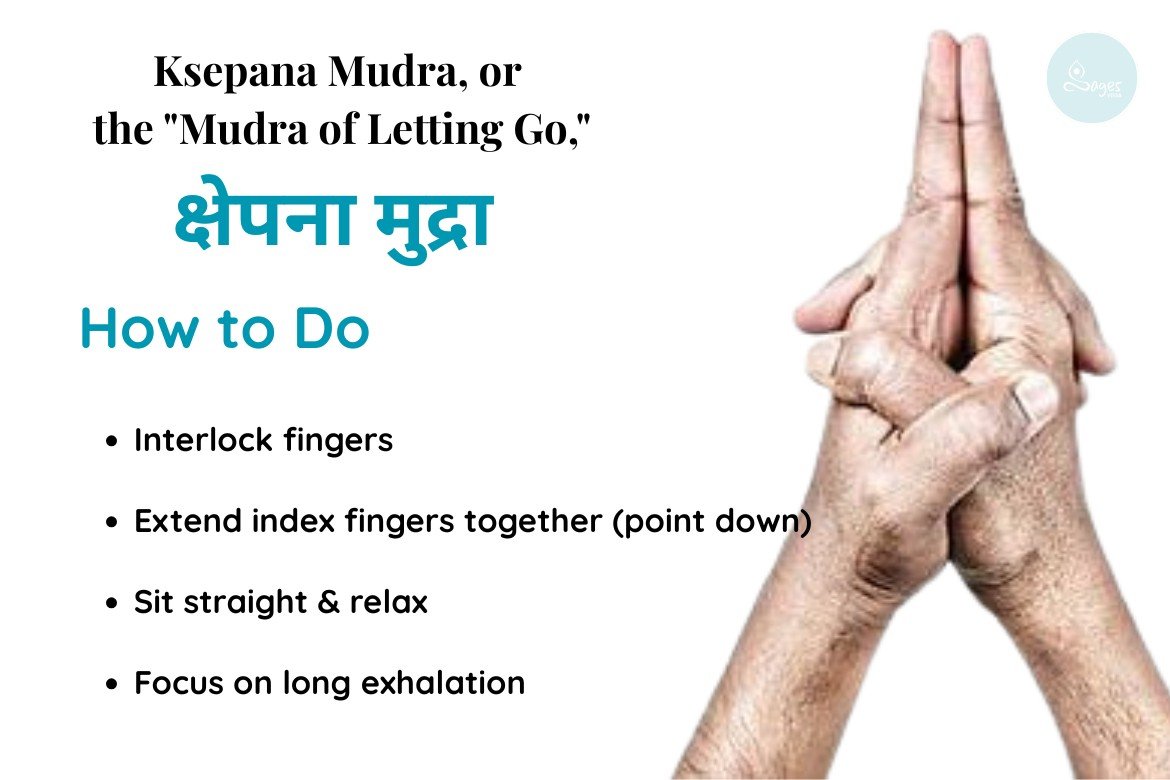
- Keep your hands in a comfortable position on your knees.
- Keep your neck and back in a comfortable upright posture.
- Close your eyes and breathe deeply.
- Dress all your awareness on the breath. Breathe deeper and longer.
- Now bring your hands slowly and gently towards the heart centre of Anjali Mudra(Or Namaste Mudra).
- Now put all your fingers together and have a rest.
- Your index fingers must be kept straight with a little gap between them.
- Cross your thumbs now and put them on one another.
- Your Index fingers are to be pointed downwards.
- This Mudra can be used to practice Meditation and Pranayama.
Read Also:- Top 7 Best Yoga Asanas for Throat Chakra
Practice Guidelines
To achieve the most successful results of this mudra, it is recommended to take into account the following traditional suggestions:
- Duration:- The usual length is 7 to 15 slow breaths per cycle. It is recommended by some practitioners that stronger effects can be achieved in up to 20 minutes; it should not be retained too long (more than 15-20 minutes) because it may eventually begin to release positive energy as well.
- Best Time:- Early morning (4 am to 6 am) is believed to be the best time to set a good mood for the day.
- Posture:- It can be either sitting (as in Lotus Pose) or lying down. Sitting, point the index fingers at the ground to ground the releasing energy.
- Affirmation:- Have a simple affirmation, such as I let go of what is no longer serving me to concentrate your intention.
Benefits of Ksepana Mudra
Ksepana Mudra is also very useful in undoing emotional burdens associated with traumatic experiences in the past, like loss, breakups, or accidents. Although it will not remove painful memories, it will make you cope with them with greater emotional strength, which will have less influence in the long term. This mudra has been especially useful when I have been working with anxiety, panic attacks, and emotional overwhelm. Pashinee Mudra is an advanced yoga posture that improves flexibility and stimulates the digestive system. This mudra will help you slowly shed off emotions that are torturing you and make way for healing and tranquillity. It helps particularly those who want to overcome past trauma that is no longer helpful.
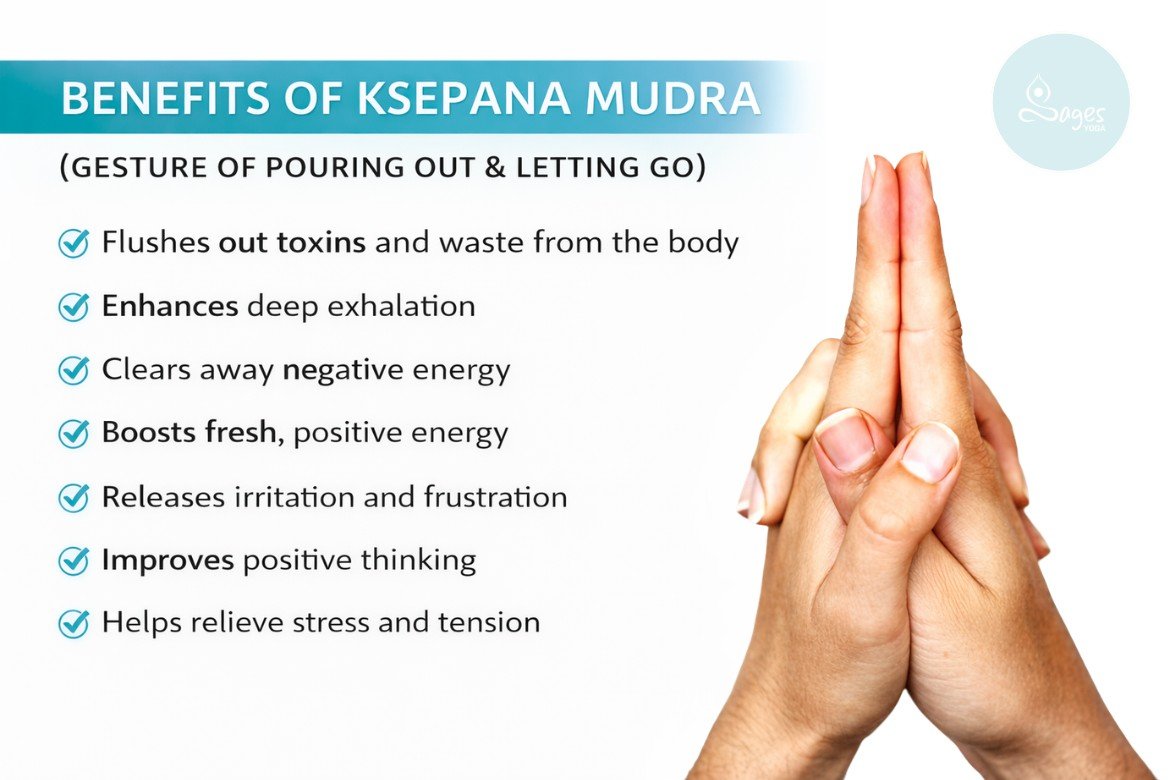
- Detoxification & Elimination:- Stimulates the natural elimination systems of the body, which helps in the elimination of waste by the lungs (exhalation), the skin (perspiration) and the large intestine.
- Vents the Negative Energy:- This is referred to as the gesture of letting go and is used to vent out negative thoughts, emotions, and tension.
- Improves Mental Clarity and Sharpness:- Relaxes an agitated or distracted mind, decreases negative thoughts, and increases concentration.
- Lowers Stress and Anxiety:- At the time of practice, it helps to decrease anxiety, depression, and insomnia symptoms.
- Balances Energy (Apana Vayu):- Balances Apana Vayu, which helps in maintaining the health of the body with respect to the pelvic floor, e.g. menstruation and childbirth.
- Increases Positivity:- Assists in shedding off the psychological baggage, allowing new and positive energy to flow through.
When to Practice Ksepana Mudra?
The Ksepana Mudra would do the most good when you are overwhelmed by negative thoughts or feelings. Use it whenever you are emotionally troubled, or when painful memories evoke anxiety or depression. You can use this mudra in your everyday meditations or yoga practice to be emotionally balanced and heal. To achieve maximum outcomes, the mudra should be practised between 5 and 10 minutes per day. With time, you will see how much more you are able to control your emotional reactions and drop what is no longer useful in your life.
Symbolism of Ksepana Mudra
Ksepana Mudra is the gesture of expelling the negativity and welcoming the positive change. The movement of your long index fingers upwards is the gesture of wanting to release the things that weigh you down and open to new chances of growth and healing. This mudra provides people with the freedom to give up to the natural healing process and be free of emotions and inner peace by adopting the principle of letting go.
You May Also Like:- 10 Effective Hip Opening Yoga Poses
Conclusion
Ksepana Mudra is not only an ancient hand gesture, but it is also an excellent instrument of self-discovery and empowerment. The energy of this mudra can be used in the middle of a full moon, particularly of a supermoon, such as the Sturgeon Moon, to release what is holding back our growth and clear the way to a happier and more satisfying life.
Frequently Asked Questions
How many minutes of practice of Ksepana Mudra?
To relieve stress in general, practice the mudra for between 7 and 15 deep breaths. Practitioners usually prescribe 5-15 minutes per day in case of therapeutic or chronic problems. It is generally recommended that it should not be held longer than 15 to 20 minutes during one session, since it will eventually begin to exhaust the positive energy as well as the negative energy.
Are there any side effects?
In most cases, the side effects of mudras are not harmful provided that they are performed properly. Nevertheless, since Ksepana Mudra is an effective "elimination" posture, you might have interim emotional discharges or energy imbalances.
Who should avoid this mudra?
It should not be over-practised by people whose constitution is too thin or with too much metabolism (high Vata or Pitta dosha) according to Ayurvedic principles, its de-toxicifying effect is too depleting to their own constitution. It is not too, as a rule, to be employed during pregnancy, particularly in the later stages, on account of the downward-flowing energy.
When is the best time to practice?
The best time would be in the early morning (4 a.m. to 6 a.m.) when the mind is at its best. It also works in the evening to shed the stress of the day.
Why is it called Kali Mudra?
It is called after the goddess Kali, who symbolizes the annihilation of the evil powers and ego. As Kali destroys in order to create rebirth, this mudra assists in destroying bad patterns to create room in which good transformation can occur.
Categories
Our Popular Yoga Courses
Yoga Teacher Training Courses in Rishikesh, India
Join our Yoga Alliance certified 100 to 500 Hour Yoga Teacher Training in Rishikesh — the Yoga Capital of the World. Learn from expert Indian gurus.
200 Hour Yoga Teacher Training in Rishikesh
Yoga Alliance certified TTC for students who want to become professional yoga teachers.