Maharishi Patanjali
Maharishi Patanjali: The Great Sage in Yogic History
The Life, Legends, and Legacy of the Sage Who Carried Yoga to South IndiaOne way or another, almost everyone has heard the name Maharishi Patanjali. He is one of the most influential sages in the history of yoga, best known for compiling the Yoga Sutras. Ashtanga Yoga — the eight limbs of yoga — is clearly defined through his work. His contributions were not limited to yoga alone; he is also credited with writings on Ayurveda, the traditional healing science of India.
Several Ayurvedic pharmacy formulas attributed to him are still referenced today. Scholars place his work somewhere between the 2nd century BCE and the 4th century CE. His approach to yoga addresses the complete well-being of a human being — body, mind, and spirit — with the final limb, Samadhi, representing ultimate liberation.
Life of Maharishi Patanjali
Maharishi Patanjali is widely considered the father of classical yoga, though the exact details of his birth remain unknown. The Yoga Sutras of Patanjali is a collection of 196 aphorisms explaining the complete philosophy, anatomy, and structure of yoga practice — a systematic guide to the poses, disciplines, and principles followed during yoga and kriya practice.
Accounts of his life describe him as simple in nature, always ready to guide and heal others. He is regarded by tradition as an incarnation of Adishesha, the divine serpent associated with Lord Vishnu. Some depictions even show him with a human body and a serpent's hood, a common symbolic device in Indian tradition used to represent divine origin.
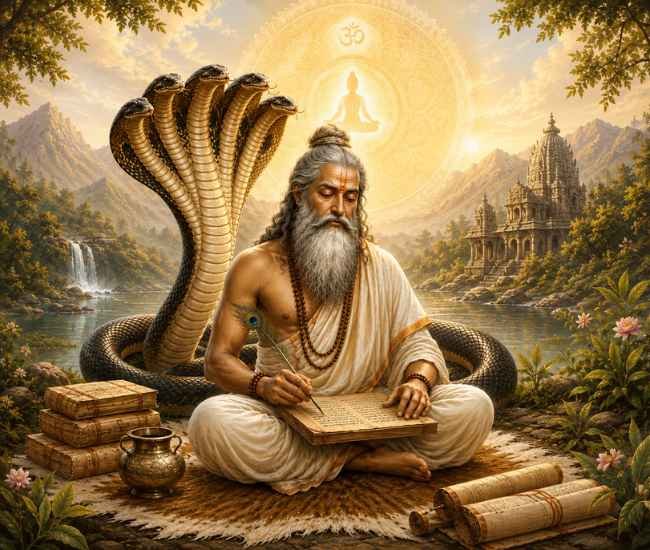
Patanjali is also credited as the author of the Mahabhashya, an important classical commentary on Sanskrit grammar — reflecting the breadth of his scholarship well beyond yoga alone. His legacy today rests primarily on his spiritual teachings and literary contributions to both yoga and Ayurveda.
Agastya Muni's Connection to Yoga and Meditation
Legacy and Connection to South IndiaFamily History of Maharishi Patanjali
Little verifiable information exists about the sage's parents or family lineage. Tradition holds that he was born divine, said to have descended from the heavens into the hands of a devoted woman named Gonika — which is why he is also known as Gonikaputra. Like other traditions associated with incarnations of Sheshnaga, he is not described as having a spouse; his life's purpose, according to legend, was devoted entirely to guiding others toward yoga and healing.
What Is Ashtanga Yoga?
Ashtanga Yoga refers to the eight limbs of yoga as outlined by Patanjali: Yama, Niyama, Asana, Pranayama, Pratyahara, Dharana, Dhyana, and Samadhi. Together, these form a complete path guiding a practitioner from ethical discipline to the ultimate state of liberation.
- Yama – ethical restraints and codes of conduct
- Niyama – personal observances and disciplines
- Asana – physical postures
- Pranayama – control and regulation of the breath
- Pratyahara – withdrawal of the senses
- Dharana – focused concentration
- Dhyana – meditation
- Samadhi – the final stage of union and liberation
In ancient India, this eight-limbed structure was regarded as one of the most precise and complete systematic approaches to yoga ever recorded.
Legacy of Maharishi Patanjali
Historians generally treat the traditional accounts of Patanjali's life as symbolic rather than strictly factual — there is no historical evidence confirming a wife, children, or direct bloodline. His true legacy lies almost entirely in the spiritual and philosophical framework he left behind through the Yoga Sutras.
Much of what is known about his life comes from oral tradition and stories passed down across generations, rather than from any verified historical record. Whether or not an actual lineage exists, his influence on Indian spiritual culture is immeasurable — the Yoga Sutras continue to shape both the practice and philosophical foundation of yoga worldwide, more than a thousand years after they were written.